

Grief never really goes away, but its initial impact takes many forms. Some people are paralysed for months on end. With others, it doesn’t properly hit them until later. For some, our self-medicated methods for processing loss in the early days involve pursuing complicated projects, designed to distract us from the overwhelming mental noise.
Such a project is what the author Helen Macdonald threw themself into following the sudden death of their father, the renowned photojournalist Alisdair Macdonald, from a heart attack in 2007. Their experiences are detailed in the award-winning memoir ‘H is for Hawk’ from 2014. It’s worth mentioning that while Macdonald has come out as non-binary in recent years, the film, which they have a producing credit on, and so presumably gave their blessing, does not frame the onscreen Helen as non-binary for its recreation of their life in the late 2000s.
Get more Little White Lies
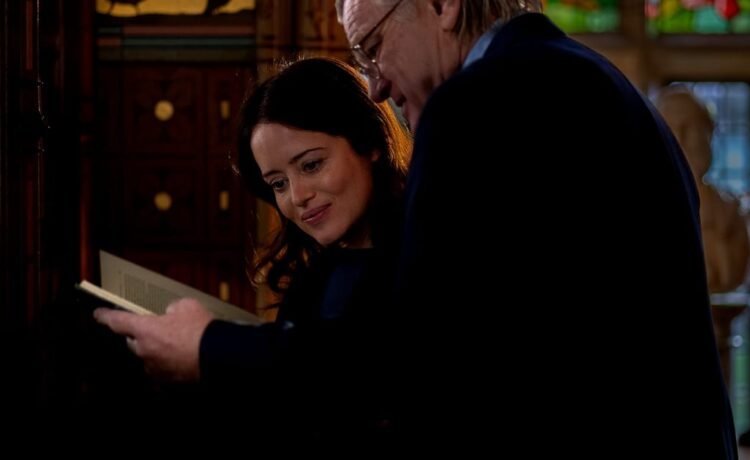
In the movie version, Helen (Claire Foy) is already at a crossroads in her academia when she receives news of her dad’s (Brendan Gleeson) death. Two months later, with a more public memorial service coming up, Helen, who has some falconry experience, dives into training a young goshawk from her Cambridge housing. Some people purchase puppies as companions through the grieving process, but she gets a hunter whose very nature forces her to confront death with attempted indifference. Becoming manically focused on her hawk’s development, Helen starts letting her other relationships and responsibilities slip by.
Directed and co-written by Philippa Lowthorpe, this gradually moving adaptation sets itself up for potential disaster by eschewing any narration of direct quotes from the book. While the memoir isn’t structured with an inner monologue per se, Macdonald’s first-person writing is heavy on vivid details that are inherently tricky to realise on film – in particular, beautiful descriptions of what a goshawk’s breath is like up close, or the memory of how a morning dew feels to the senses.
You can try translating those situations visually, but in lieu of having the onscreen Helen narrate lines from the memoir to accompany your image-making, attempting to evoke similar sensations puts considerable pressure on your lead actor, who in the goshawk-training sequences says little outside of trying to command the bird of prey that could plausibly tear their face apart. And due to the real animals being used as scene partners, the body language of the performer has to lean towards subtlety over broader gestures, for the safety of the small crew trying to film the interactions.
F is for Face is the most important part of the acting, and luckily, Foy excels at the assignment, conveying so much of the physical toll in her eyes and the tiniest facial flickers alone. If the film occasionally falters with its relative lack of incident across nearly two hours, Foy’s performance – especially in the transfixing training scenes captured in long, unbroken takes – tells several stories on its own.