
(RNS) — Faith communities have long been places where people with different perspectives gathered and built relationships. But today, many find those spaces look different.
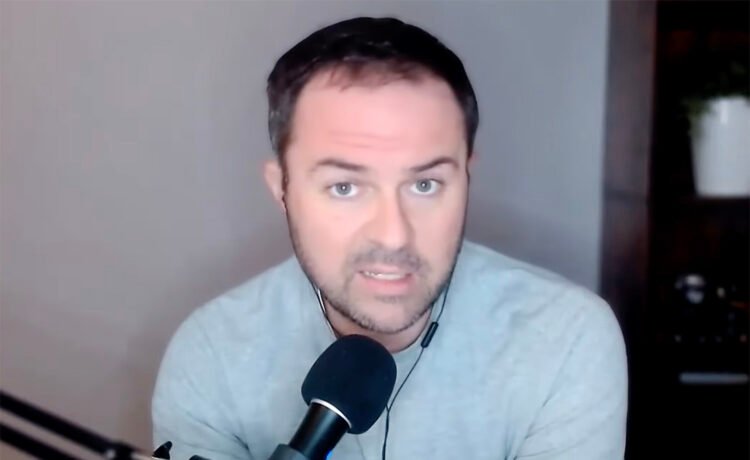
Social scientist Ryan Burge, whose research examines how polarization intersects with American religious life, spoke at an RNS virtual event this week to share his insights about what polarization means for congregations, community life and the country’s civic landscape. His new book, “The Vanishing Church: How the Hollowing Out of Moderate Congregations Is Hurting Democracy, Faith, and Us,” examines how political polarization has changed congregational life over the past several decades.
Burge was interviewed by Adelle M. Banks, RNS projects editor and national reporter, and he took audience questions from Niala Boodhoo, RNS live events host. The transcript was edited for clarity.
ADELLE M. BANKS: Ryan, you dedicate your book, “The Vanishing Church: How the Hollowing Out of Modern Congregations Is Hurting Democracy, Faith and Us,” in part to “the faithful few” of First Baptist Church of Mount Vernon, Illinois. What did that church, which was long affiliated with the American Baptist Churches, and whose closure you had to oversee, teach you firsthand about what you call the vanishing church?
RYAN BURGE: My life has always been bifurcated between my personal being as a pastor, and then my public-facing work doing the data. One reinforces the other, one teaches me about the other. I always wondered if what I was seeing in my own life was being reflected in the larger religious landscape of America. What I found over and over again is that what we’re facing is not at all unique to what lots and lots of congregations are facing across America.
It was a church that used to have 300 or more in worship in the 1960s, when they built a brand-new building because they’d outgrown their building. They moved from downtown to the edge of town — the classic thing churches do. There’s more space, more land, more opportunity to grow. But it was down to 100 by the mid-1990s, and down to 50 by 2006, when I arrived.
During the course of my ministry there, my church vanished. We had some Sundays in the last year where we had eight or 10, including me, during the worship service. It happened so slowly that you don’t even sort of think about it. Like one person here, one person there, and in a church with 300 people, losing one person or another doesn’t really hurt that much. But when you’re down to 30 people and you lose one, that’s a lot.
At churches like mine — moderate, middle of the road, sort of apolitical, non-political — it’s just a lot of people who like the community of the church, like the history of the church, like what the church stands for, are looking for a place just to worship together without any sort of outside nonsense and noise. That’s what people were looking for, yet churches like that are the ones that seem to be struggling the most in America right now. There’s going to be thousands of churches just like my church that are going to be closing over the next five, 10, or 15 years.
BANKS: What about the church where you grew up?
BURGE: I grew up a prototypical evangelical — small, rural, very white church, very conservative, in the middle of nowhere in Illinois. In the 1990s, things were really starting to change. I was a kid, in youth group, and I didn’t really understand the macro-level forces, but what I did understand was that my church is becoming more conservative.
In 2000, my county was 51% for Bush and 48% for Gore. So, very purple. That same county today is 80% for Trump and 20% for Harris. A big reason the county shifted is because churches like the church I grew up in shifted. It used to be there were Republicans and Democrats who sat side by side, and if you look at the 1970s, a majority of white evangelicals were actually Democrats. They were Dixiecrats, but they were Democrats.
By the mid-1980s, late 1980s, the share of white evangelicals — Republicans and Democrats — was about the same, about 45% each. So, what we’re really seeing with white evangelicalism is something that happened in the last 30 years. It hasn’t always been this way. The idea that white evangelicals have always been very conservative is demonstrably false. White evangelicals were politically divided for a long time.
So this current situation is really unique. There’s not been any large religious group in America that’s that politically homogenous. A lot of people who grew up in an evangelical church that was certainly right of center, but not far-right of center, is kind of looking around going, “What? What is this? Why did this happen?”
BANKS: What does that mean for the country that there is not a lot of heterogeneity within different congregations, especially evangelical ones?
BURGE: I hope what comes across in my book is just the power of contact — being in contact with people different than you. It’s very easy to create a caricature of the other side in your head and then just hate that version of it. It’s harder to have disdain for someone who you sit next to in a pew every Sunday, you take communion with every Sunday. Just because they happen to vote for someone who you disagree with doesn’t mean that you hate them, doesn’t mean you think they’re a terrible person.
The screens we’re on right now have sort of reduced the humanity of the other in a way that makes us two dimensional right now. But if you sat next to me in church for the last 17 years, you would realize I’m just a person just like you. We might vote differently and think differently, but we’re not bad people. I think that’s the core of this political homogenization. The title of the book perhaps should be “How the Hollowing Out of Politically Heterogeneous Churches” — but that’s very social science-y. We want a politically diverse church, not where everyone’s moderate. I want to be clear that I mean by that is you have Republicans and Democrats, liberals and conservatives and Independents, and they sort of balance out towards the middle of the political spectrum. Those are the kind of congregations that actually serve democracy the best and make it possible for us to govern ourselves going forward.
BANKS: You point out that the rank-and-file at mainline Protestant churches are politically heterogeneous, but you say bluntly that mainline Protestant Christianity is headed for extinction. What does that mean for the future of the nation?
BURGE: First, let me couch this by saying I don’t dance on the grave of mainline Protestantism — Methodist, Episcopalians, Lutherans and Presbyterians. I was a pastor in an American Baptist Church for 18 years. I go to a United Methodist Church now. But the data is hard to refute. The mainline was 30% of America in 1975, 8% of America today. Among Gen Z and millennials, 5% are mainline Protestants. The denominations that used to dominate American life, cultural life, religious life, are going to be gone, or be vastly reduced in their ability to influence and change society.
“The Vanishing Church: How the Hollowing Out of Moderate Congregations Is Hurting Democracy, Faith, and Us” by Ryan Burge. (Courtesy image)
People assume that mainline Protestants are liberal — probably because the clergy are liberal. The rank and file are very moderate. Sixty percent of United Methodists voted for Trump. A lot of those denominations are 52 to 48 (percent). So the idea that the mainliners are this counterbalance to the conservatism of evangelicalism is just false. That’s not true. They’re actually middle of the road.
And the point I make in the book is that famous Margaret Thatcher quote where, if you stand in the middle of the road, you get hit by cars coming and going. And the mainline has always struggled with that. As a mainline pastor, I can’t tell you how many times evangelicals told me that I wasn’t a real Christian. But then my atheist friends would say I’m too conservative because I actually have a belief in Jesus, and I actually do recite the Creed and believe it. That’s always been the mainline problem, and it’s only accelerated in a world where everyone wants to code you as left or right. When you resist that call to one side or the other side, you end up being disliked by everybody. The mainline identity has always been moderation, and right now that means not having an identity.
BANKS: The Catholic Church has growing diversity, but its leaders are becoming more and more conservative. Where do you expect that to lead in years to come?
BURGE: It used to be that Catholic priests were fairly diverse. You had liberal priests and conservative priests and middle-of-the-road priests. If you look at priests who have been ordained in the last five or 10 years, 85% of them identify as conservative theologically, and the same share identify as conservative politically. So, there’s no doubt in my mind that there will be very few leading liberal voices in the Catholic hierarchy in the United States in years to come. You can already see this in the United States Conference of Catholic Bishops. On immigration they have pushed back against Trump, but clearly they were no fans of Democrats, and they’ve said that Nancy Pelosi can’t take Communion, Joe Biden shouldn’t take Communion.
White lay Catholics used to be a mixed group, maybe slightly toward the Republican side. I think 55% voted for McCain in 2008. But now 65% of white Catholics voted for Donald Trump in 2024. So even the white Catholic vote, which I used to always say like America looks like Catholics and Catholics look like America — that’s not true anymore.
We almost at a point where to be religious in America is to be conservative, especially if you’re white.
BANKS: Where do Black churches and Latino churches fit into this picture?
BURGE: Black Protestants are their own category in religious classification. People ask, ” Why is that?” And the answer is because they don’t fit really well into mainline or evangelical because in some ways they’re actually very evangelical, on prayer frequency, church attendance, evangelism, even on doctrinal issues like views of the Bible, views of gender, views of sexuality — very conservative on many of those things.
But here’s the rub of the whole thing: 80% of white evangelicals voted for Donald Trump, and 90% of Black Protestants voted for Kamala Harris. So it’s a different world. There is some evidence that Black Protestants are slightly moving to the right politically. Ten percent voted for Trump in 2016, and it might be 16 or 17% now — not nothing, but not a tectonic shift. It could be just because of what the Democrats are doing right now, but we don’t know if it’s just a one-off thing, or a trend.
The Hispanic Catholic vote is fascinating. They were very anti-Trump in 2016, as Trump obviously had these hardline immigration policies, which would have affected those communities directly. In 2024, however, the Hispanic Catholic vote and the Hispanic evangelical vote shifted to the right about 10 points. So they’ve warmed up to Trump. A lot of groups in 2016 were very skeptical of Trump, but by 2024 that skepticism faded for many of them.
For Latter-day Saints, only 52% of them voted for Trump in 2016, but in 2024 it was 65%. Even among non-white Christians, because they like Trump’s messaging around traditional values, family, quote-unquote “family values,” about gender, sexuality and things like that. So I see it’s almost like if you’re a religious person in America, you’ve shifted to the right over the last 10 or 15 years, and that’s across the board, whether you’re Catholic or Protestant, whether you’re white or non-white. Christians in America especially have moved to the right on political matters.
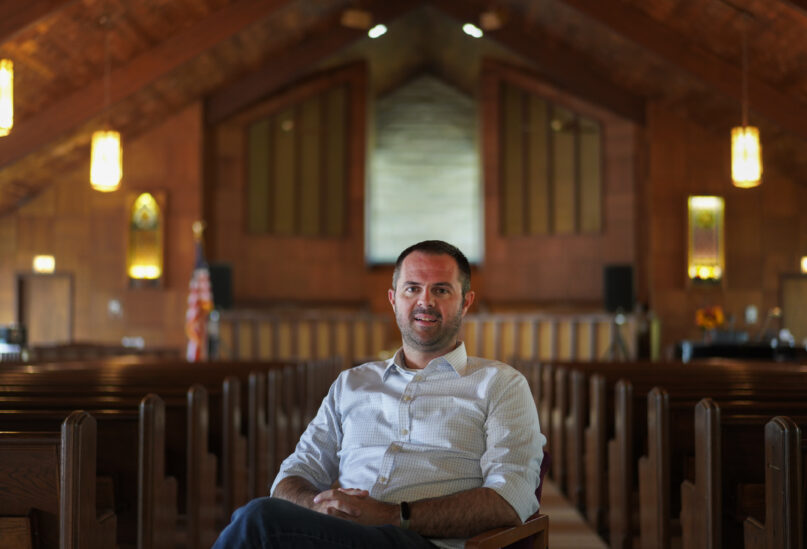
FILE – Pastor Ryan Burge poses for a portrait at First Baptist Church in Mt. Vernon, Ill., Sept. 10, 2023. (AP Photo/Jessie Wardarski, File)
BANKS: That’s not everybody that’s done that, but you’re seeing this shift among a number of different groups.
BURGE: Yeah, it’s really across (groups) — and that’s the most amazing thing is it’s almost like Christianity is conservative in America, at least that’s the way it’s being perceived, especially by the next generation. I tell my students all the time, they really have no concept of Christianity that we would call liberal or left of center. They think it’s just all conservative because that’s what they grew up with. That’s the predominant strain that we’re seeing right now.
BANKS: Or what they may be seeing on TV or seeing online, which may not be the whole picture, but it’s what people see. Your book included a moving anecdote from your college days about a couple that came in and sat in the back row of the church you were at. And there was that time that’s traditional in some services where people can say that they have this particular prayer request. This young man was here with this young woman and carrying a baby, and he asked for prayer because he’d lost his job and he didn’t know how he was going to pay rent. I’m wondering whether that anecdote, that ended with a man coming up to him and offering him a job at a lumber yard, does that even happen anymore? Can it happen when there’s so much — or so little, actually — economic and educational and political variety that you point out in many congregations?
BURGE: I think it’s happening less and less every Sunday, unfortunately, for two reasons. One is that that kid would not be coming to church today. I look back on that kid — I want to find him, he’s now in his probably late 30s. What drove you to come to church? What was the impetus to get you there? Because that’s a bold move, first off, to show up. You’re young, you’ve got a wife or a girlfriend, you don’t know anybody there. You sit in the back, you come in late. You don’t typically see that in a lot of churches.
And not only that, the courage to actually say during prayers and praises that, “I lost my job, and I don’t know how I can afford rent.” That takes a lot of gumption to say, “I need help.” And I think a lot of people, especially with this sort of rugged individualism in America, don’t want to ask for help. I give kudos to that guy for several reasons.
And the other thing is, I don’t know if we preach a gospel of personal responsibility and someone says something like that in church, do people automatically think, ” That’s your problem, dude. How did you get yourself in that situation? That’s your fault, not my fault.”
So, I do think it’s a both-and situation, which, just speaking from my perspective as a pastor, we teach people to help people. That’s what the gospel message has always meant to me is helping people who are struggling. The last shall be first in the kingdom of heaven. And I think that situation, take the spirituality out of it for a minute. That’s how people at the lower end of the economic spectrum sort of move up the economic ladder and move into the middle class is by having connections with people that can help them get a job or get a promotion or get a better job.
And if we don’t have those rungs anymore, there’s no connections to the middle class or upper middle class. People at the bottom rung, you’re going to shoot your resume into the void of AI reading thousands of resumes? That’s not how we get ahead. So I think in some ways, it’s actually exacerbating some of the social problems that we’re facing in America, too, beyond the spiritual issues and the political issues. I think there’s economic inequality that’s being driven by the fact that people at the bottom end of the economic spectrum have stopped going to church and stopped speaking needs into churches like that.
BANKS: You also talked about the internet and how it’s changed the religious landscape. Can you talk a little bit about that related to political divides, and not only the younger Americans, who you say may not want to go to a church, but also the nones and the atheists? How does the internet give them power, perhaps, or give them a different way of approaching religion?
BURGE: It’s hard from a social science perspective to prove it’s the internet that did all these things because everyone in America got the internet in like a five-year window of time. We went from like 12% to 80% within like five years. There’s no control group there.
But it’s unmistakable, it’s undeniable, that it had an impact. And I think in good ways and bad ways. I think in good ways that it allowed people to find people they would have never found in real life — people who have an interest or want to learn more about something. And that’s fantastic. The internet’s amazing for that. I always say, if you were an atheist born in Mississippi in 1950, you might never tell a soul you were an atheist, because why? You’d be ostracized from your community, and you might have problems finding a spouse or friends or anything, a job.
But now, if you’re an atheist in Mississippi, you can find a sub-Reddit or a Facebook group, and it makes you feel like you’re less alone, which is an amazing thing. I think we all need connection and community and to feel like that, which is good. But then you also have crazy people, like conspiracy theorists, finding each other and reinforcing their crazy beliefs. So that’s the downside of this whole thing.
In terms of religion, though, what I think it’s done is it’s just reinforced the inclinations that people have already. If you are going to look for reasons to not like Judaism or Christianity or Islam, you can find more reasons in five minutes than you could in five hours 50 years ago. So, if you’re looking for something, you can find it. If you’re looking for more reasons to believe in Judaism or Islam or Christianity, you can find that as well. So, I think it’s kind of helped us scratch our curiosity itch in good and bad ways.
But I think the modern iteration, the social media iteration of this, is really caustic because, let’s be honest, algorithms are designed to keep us on that platform as long as humanly possible. And what keeps you on a platform? Controversy and weird opinions and hot takes. And what it does is it sort of elevates the fringes of political discourse in America. And I think in some ways, it’s warped our sense of what normal is. I think that’s a really important point, is now we don’t know what the average American feels like because the average American’s opinion is not being amplified on social media. It’s the people on the far left and the far right that get amplified.
And it leaves the rest of us kind of sitting around going, “Wait a minute. Am I the weird one? Or are they the weird one?” You sort of lose sense of what normal is. And I think that might be the real implication of social media, specifically. And I guess that’s where I would step in and say, “Hey, I can tell you statistically what normal is, and that’s not normal.” And yet, unfortunately, other people don’t have the opportunity to do that, or don’t have the background knowledge to understand those things.
BANKS: There’s a chart in your chapter on how religion has become a tribal identity that breaks down by religious tradition. What portion of the population identifies as evangelical or born again? More than 10% of some of the groups who have little in common with evangelicalism embrace that identity — 24% of Mormons, 16% of Catholics, 15% of Muslims, 11% of Hindus. Please explain this.
BURGE: Yeah, this one gets me in a lot of trouble on social media whenever I post it because they’ll say, “Why did you ask Jews if they’re evangelical or not? Why do you ask Catholics? Why do you ask Hindus?” First off, I didn’t ask anybody. I want to be clear about that. It’s not my survey. Cooperative Election Study did it. But I love the fact they did, because we see people say yes to that question.
The first inclination that people have is that it’s survey error — when survey error is people like (clicking) the wrong button or trying to speed through the survey to get to the prize at the end, the monetary compensation. But, here’s what’s funny: I can actually predict what would make people check that box on evangelical. And it is, “I’m a conservative” or “I’m a Republican.”
If you look at each of those non-evangelical groups, like Catholics, like Jews, like Hindus, like Muslims, what you see consistently is people who are conservative are significantly more likely to say they’re evangelical than people who are liberal. And that tells us something. It’s not random. It’s not survey error if you can predict what causes it. And it’s “I’m religious and I’m conservative.”
So you’ll see Muslim evangelicals, and that’s what they say, “I go to mosque often, and I vote for Donald Trump. I’m an evangelical” because they think the word evangelical means cultural conservatism, political conservatism, religious conservatism. This is a great example of, we don’t own words. That’s not what evangelical means. There is no great dictionary of what words mean to everyone. You get to decide.
And so, my job as an analyst is not to shake my finger at these people and say, “Oh, you’re wrong. You can’t be evangelical.” It’s to go, “Wait a minute. Why did you say you were evangelical? And is it just because you don’t know what the word means, or because you understand it differently than I do?” And I think the evidence strongly points toward that second conclusion, is people are understanding the word evangelical in a way that traditional evangelicals would not understand it. But good luck trying to bring it back to the right quote-unquote definition. People can read into words whatever they want those words to mean. And that’s what’s happening with evangelicalism, I feel.
BANKS: I feel like the definition has evolved, and people need to understand that when they choose to use that term. You seem to be saying that average Americans are not that interested in being polarized. But they feel like, nevertheless, they kind of have to fit in, have to be polarizing in this political and religious landscape. So, do you have any particular advice to the people who you say are in the “go along to get along” group?
BURGE: Yeah, that’s the group that, I think, again, the data says most Americans are in that moderate middle. And one of my favorite anecdotes is, I think Jon Stewart had this rally where people brought these moderate signs, like, “I don’t usually protest, but good gracious.” Like, “Introverts of the world unite and then go back to your homes.” It’s all these people have opinions, but they’re always towards compromise and seeking the other side and finding a middle way.
And those kind of voices of compromise don’t get you elected anymore it feels like. I’m looking back at 2016, for instance. Donald Trump’s biggest critique of his competitors, which were Rubio and Cruz, were that both those guys were working on a compromise bill on immigration to provide a pathway to citizenship for people who were here illegally but hadn’t committed any crimes. And he used that as a cudgel against them because now you’re capitulating on immigration. Guess what? Most Americans on immigration are in the middle. They’re seeking for some sort of pathway.
The problem is those moderate people are afraid to speak up in these congregations. And I’ll admit, I’m the same way. It’s hard to say the moderate thing when the non-moderate person is speaking because you don’t want a confrontation. Because here’s the reality: that person, that fringe person, you’re not going to convince them that they’re wrong. You’re not going to convince them to change their mind. And so, it’s just easier for us to sit on our hands and let them get it out of their system than it is to say what we actually think.
And so, I think this is a process that has to start from the bottom up, not the top down. You’re not going to go to the United States Conference of Catholic Bishops and saying, “Hey, could you guys moderate on abortion policy or female priests or whatever it is.” But what you can do from the bottom is find other people who have the same opinion as you. And when you find those people, be willing to say things in that group that other people might hear and go, “Oh, yeah, I actually agree with you on those things.”
I think it’s got to be sort of an organic thing that happens from the pews. Don’t ask your pastor to do that because they got no incentive to do that, and they don’t want it. They want to avoid that as much as possible. But it’s hard to ignore when your congregation is telling you, “Hey, can you help us figure out how to compromise on this issue? Can you figure out how to find the middle way on this issue?” I think it has to be more moderate people be willing to stand up and saying, “I’m moderate on this stuff. I want to see the other side.”
Unfortunately, you deal with absolutes online. I’ll give you a good example. James Talarico was on Ezra Klein last week, and he was asked, “Do you think Christianity is true?” And he goes, “Yeah, I think it’s more true than other faiths, but I think I can find truth in other faiths as well.” (He) got killed online for saying that: “You’re a universalist, you’re a heretic, you’re not a real Christian.”
But guess what? The data says a lot of people agree with James Talarico on this issue, but none of them spoke up in the comments. That’s the problem, is whenever someone moderate speaks up, they get destroyed by the far left and the far right. And the moderates go, “I don’t want to get destroyed too, so I’ll just be quiet.” And so, we’re sort of prisoners to the extremes of American political discourse.
BANKS: And that’s on the political side. On the spiritual side, you say that churches should be a place for doubt, which is where mainline churches have been. So how does that idea fly in the midst of all this polarization and the strength of evangelicalism, which may be less on the side of “let’s doubt”?
BURGE: I think it’s constantly reminding yourself that there honestly are people who are predisposed to certainty, and there are people who are predisposed to less certainty. I don’t say uncertainty, but less certainty. And the people who are predisposed to certainty, I think have an air of moral superiority that needs to be challenged a bit more. I’m a Christian, if you look at the Christian scriptures, you see so many examples of doubt. You know, “Lord, I believe. Help thou my unbelief,” right? There are people who came to Jesus and said, “I want to believe in you more. How do I get there?” There’s Doubting Thomas, right? There’s Peter. There’s all these examples in the scriptures of people who struggled to know what the right thing to do was.
And yet, in the modern discourse, it seems like if you want to say something so controversial as, “Yeah, I’m really struggling with the idea of the bodily resurrection of Jesus Christ,” it’s like, “Oh, you’re out of the tribe. Now you’re unorthodox, and we’ve got to kick you out of the situation.”
I think it’s got to be people who are willing to say, “I believe these things as best I can, and I’m trying to believe them more. Would you help me on that? Would you support me in that position?” And if those people won’t support you, honestly, they’re not your people anyway. You got to find people who are saying, “I’m struggling, I’m doubting. I’m walking through this uncertainty, just like you are, and I’ll walk with you.” What’s that famous phrase? “The two most powerful words in the English language are ‘me too.’” That’s the best thing. When I was a pastor, I would get there at the pulpit and say, “I’m really struggling with this passage today. Here’s what I think it means, but I’m not entirely sure.” And then someone from the congregation would go, “Ryan, I felt the same way about this passage. I really don’t know what it’s trying to tell me, but I’m struggling with it just like you are.”
There’s nothing more edifying than feeling like you’re not alone in this world. And so, I think those voices in the congregation need to be elevated, those positions. And I think that’s an area, by the way, where the clergy can lean into it, right? Can model humility. For instance, I heard a pastor one time give this really fire and brimstone sermon, and at the end, right before he closed, he goes, “Yeah, but I could be wrong.” And I thought that was the coolest thing ever because it was like, let’s give you that opportunity to doubt me or question me. Maybe I did get it wrong.
That’s something that I think that we need to be more willing to accept, and I think churches need to be more willing to model that humility and that uncertainty and that doubt from the pulpit. And unfortunately in evangelicalism, it’s almost a liability to do those things.
BANKS: In your chapter that says “not all is lost,” you point out that two-thirds of Americans, 63%, say that religion is either very or somewhat important. What does that mean in relation to your other findings?
BURGE: I get asked other questions, like, “What’s your hope?” Because I always feel like I’m the prophet of doom. America is an incredibly religious country, much more than Western Europe. On questions of belief, 85% of Americans say they believe in a higher power or God. Only 15% say they’re atheist or agnostic. And by the way, among Gen Z, it’s 15%. So, Gen Z is not like walking away from a belief in God at this really high rate. They still believe. And religion is important (for) 63% of Americans, there’s still a great well of faith in America.
It’s not like you’re trying to convince people to care about something that they don’t care about or they don’t value. It’s just you got to get them from, in my mind, “I theoretically care about it” to actual practice, actually going. And this is something really important from the social science: if you look at the different ways to be religious, whether it be belief or belonging or behavior, the most valuable one from a social science perspective is the behavior piece. Going to a house of worship on a regular basis is the most important one. That’s the one that I think we need to convince people to come back to, whether it be a synagogue or a mosque or Unitarians or LDS. I don’t care. Just go. You’re going to see so many benefits from that.
And again, they’re already halfway there. You just got to get the social piece activated for many of them, and take it out of the realm of the theoretical and make it very, very practical, very earthy, and very relevant to their lives. It will make their life better if they commit to it. I really do believe that, by the way. If the average American committed to going to a house of worship on a regular basis for six months or a year, their life would be better after six months or a year in ways they would not even be able to perceive at the time. But it’s hard to convince people of that because we’re moving in an anti-social direction.
BANKS: Yes, and you said that the notion of religious importance is higher probably than many people may believe. You said in your book near the end, you’ve never been more hopeful and more afraid for the future of the United States. Do you still feel that way?
BURGE: More and more every day. I try to hold those two ideas in balance with each other. I don’t want to give myself over to the politics of fear. I think that’s our worst impulses. There’s things happening in America right now that I am afraid for, and not just political stuff. I’m actually more worried about the social stuff than the political stuff because the political (situation) we’re in right now is not going to last that long. The social stuff has been ongoing now for decades. The move away from socialization predates the internet. Robert Putnam talked about this in “Bowling Alone,” this was happening in the 70s and 80s with the decline of bowling leagues and the Legion and the Moose and the Boy Scouts. We can’t just blame the internet for this thing. The internet accelerated it, but it’s been going on for decades now. So that, to me, is like a bigger thing I worry about.
But man, I really do believe we live in the greatest moment in the history of the world, and tomorrow is going to be better, and the day after that’s going to be even better. I can give you data point upon data point. For instance, in the 1970s, you got cancer, there’s a 50-50 chance you’d be dead in five years. Today, it’s a 30% chance you’d be dead in five years. that is an absolute miracle. We have cured Hepatitis C, we’ve cured cystic fibrosis. HIV/AIDS used to be a death sentence. It’s not a death sentence anymore. The amount of suffering that we go through in the world is so much less than our ancestors ever thought about.
Think about how many times you read history and someone said, “Well, they had 12 kids, and six of them lived past their fifth birthday.” And now if one kid dies, it’s an absolute tragedy. The world is a wonderful, beautiful place, and everything that we’re facing can be solved. There’s nothing intractable about our current situation, if we would be willing to lean into solutions to those problems. Not that they would be easy, but they’re plausible, and I think that’s the most important part.
BANKS: Thank you. I just want to ask you one more thing before we switch to Niala, who’s going to field questions. And at the end of your book, you said, going back to talking about your personal experience, “Where would I worship when my church closes doors? Would I ever go back to church again?” It sounds like the answer to that second question is yes. But can you just tell us that before we open up for questions where you are on all of this yourself?
BURGE: I go to a United Methodist Church. It’s the kind of church that I like. It’s apolitical. There’s no rainbow flags out front, nor are there MAGA hats. It’s just a place where people come and worship, and they’ve accepted me as I am.
Of my congregation at the end, there were about 10 or 12 people on a good Sunday. And five of them worship at the United Methodist Church.
But here’s the sort of the coda to all that. In my county, of about 40,000 people, there are a total of four mainline churches left. Three of them have less than 30 people in worship. So, this is the only sort of large-ish (one) — and it has like 125 in worship. Looking around the congregation, there’s a whole lot of baby boomers, whole lot of gray hair. So, demographic things I would talk about in the book, is I really worry about the future of that church, too. In 20 or 30 years, it might not be the same way, just because of demographic change and all those things.
I was like likening it to polar bears on ice floes with global warming, when your ice floe starts melting, you jump off and swim to another one. But the thing is, those ice (floes), they’re getting farther apart, they’re getting smaller. So, I wonder where people like me, polar bears like me, are going to end up in 20 or 30 years when there are no ice floes. The choices are evangelical or Catholic or nothing. I think a lot of people would like another option. They would like a third or fourth option there, and they’re not going to have them in many parts of the country. And I think that’s actually the real problem, is people want to be spiritual. They want to express their faith. They want to be part of a community, but there is no community to be found because all the structures of community will be dead or dying by that point.
So I’m thankful for where I’m at, but also very wary of what the future looks like in 20 or 30 years.
BANKS: Thank you so much, Ryan. I’ll turn it over to Niala.
NIALA BOODHOO: Thank you, Adelle. Thank you, Ryan. I think there are a lot of polar bears in the chat also because they have a lot of questions for you that I would love to get to. The first one, Ryan, we’re getting a lot of questions about definitions. What do you mean specifically by conservative, liberal, progressive, even evangelical, as you’ve sort of given us this expansive definition. How do you understand those terms now?
BURGE: So here’s what’s great about survey design. We don’t define things. This is the comment I get all the time, really almost daily, is, “How do you define conservative? How do you define liberal?” Or, “How do you define spiritual or religious?” “How do you define these terms?” And here’s the reality: if I tried to define the word conservative and I showed it to 100 people, 95% of them would disagree with how I defined it.
So instead of trying to define it, what we do is just put the word out there. And these surveys have been asking these same questions with these same terminologies now for 50 years. And what’s fascinating, and this is what I don’t think people fully realize is if you look at like the median American on this liberal-conservative scale, they’re exactly in the same spot today as they were 50 years ago, almost right in the middle. And so the thing is, people assume these words are changing, and in some ways, it is true. But then why does the median American find their way back to the middle no matter what these words mean?
So that, to me, is pretty strong evidence that we wouldn’t want to define terms on a survey anyway because of what I just told you. It also would take more time so you could ask fewer questions. But people are pretty good at figuring out what words mean and placing themselves in the spectrum.
Now evangelical in the book is defined two separate ways. One is through self-identification. Would you consider yourself a born-again or evangelical Christian or not? So yes or no, right? That’s called self-identification. The other way is through denominational affiliation. So we actually have a whole rubric. If you say you’re a member of a certain denomination, we classify you as evangelical, mainline, Black church, Catholic or whatever else. So if you say you’re Southern Baptist, we classify you as evangelical. Say you’re Assemblies of God, we say you’re evangelical. Say you’re United Methodist, that’s mainline. Episcopalian, that’s mainline. So, there’s two ways to do it, and I do both in the book. I try to define, try to be clear about when I do one and when I do the other. But there’s no right way — again, words mean whatever you want them to mean, right?
BOODHOO: And on a related note, John Knight asks, are there any vocabulary or labels you no longer use yourself?
BURGE: Yeah, I would never use the word fundamentalist on a survey because it just has such a wide connotation. The people who are going to say yes, I wouldn’t even know why they would. If you read old political science, religion and politics, they use the word fundamentalist a bunch, and they say it’s like a subset of evangelicalism. But again, if evangelicals now are 80% Republicans, where is fundamentalism inside that now? So, I think in some ways, evangelicalism has eaten fundamentalism and now those two words almost mean the same thing. So that’s a word I would definitely not use in the survey, is fundamentalism.
BOODHOO: As we’re talking about definitions, we got a lot of questions that basically revolved around whether people have moved to the right, or has the left moved more to the left? When you’re seeing this polarization, are they more vocal?
BURGE: That’s probably the biggest flaw of my book, honestly, there is no (definition of) what it means to be a liberal and what it means to be (conservative). I’ll give you a good example right now. In 2000, I thought conservatives meant free trade. That’s what the core of the Republican Party was for decades, was free trade. And then the Trump administration puts tariffs in. That is the antithesis of free trade. We don’t even know what these words mean.
The problem, though, is, I think the Democratic Party, and this is something I’ve said publicly and I’ll say it here, I think the Democratic Party has done very little to cater to people of faith for reasons that elude me. I did an analysis I wrote for RNS a couple years ago where I scraped the tweets of Democratic candidates running for president, so Buttigieg, Klobuchar, Biden, folks like that. And I look for religious terminology in those tweets. They actually tweeted more about Islam than they tweeted about Christianity.
BOODHOO: Do you think that’s changing now? Like with folks like James Talarico, or not?
BURGE: I think there is a concerted effort among some Democrats to lean back more into their conservative base. But I don’t think the median Democrat is comfortable honestly talking about things like that because 45% of Harris voters were atheist, agnostic or nothing in particular. So, half the Democratic coalition. And if you’re running in an urban area, it’s higher than that. It’s a majority of your constituency are non-religious people. So how do you message that? I would say that’s the hardest part about being a Democrat is, how do you message to atheists and Black Protestants at the same time?
On economic issues, I think you can pretty well, but on social issues, good luck. I think that’s the real flaw of the Democratic Party right now, is they’ve forgotten that 63% of Americans are Christians, and you still have to have a lot of Christians vote for you to win, whether you’re a Democrat or a Republican. And I think they’ve sort of catered to the fringe more than they should. Not that the Republicans haven’t done that too, but that’s a different story.
BOODHOO: This is a question from Pamela. How do you see this changing with ICE deportations and church leaders speaking out?
BURGE: I just saw it over the weekend. There’s that church — I don’t know, what verb I use here is going to be wrong — there were protesters who interrupted a church service of a Southern Baptist church in Minneapolis because one of the leaders of that church was a field director for ICE, which you can read about on RNS. And what’s so fascinating about that is you’re seeing that people don’t know how to feel about all this stuff, right? What you’ll see is a lot of people say, “OK, first off, what ICE is doing is inhumane, and we’ve got to stand up to that however we can. So that’s justified in disrupting a church service.” But then you see other people saying, “But no, church services are sacred, and they’ve always been sacred. Your First Amendment rights to worship should not be infringed.” But then you see other people say, “What, you can’t be a Christian and be a field agent for ICE right now.”
So it’s like all this debate and discussion about what it means to be a Christian, and (where) you stand on moral issues. I think is a fascinating lens in how we think about politics and morality and humanity in all these things. And no matter what you say on this issue, by the way, you’re going to be wrong. That’s what I’ve realized. There’s going to be a lot of people on the far left or the far right. If you say that those people disrupting that church service were wrong, the far left is going to be mad at you. If you say they were right, the far right is going to — you can’t win in this situation.
And that’s the problem we talked about earlier: the fringes are dominating this debate. I’ll just state my position plainly. I think we should never, ever disrupt a religious service in America, left, right or center, whether it be an Islamic mosque or a Jewish synagogue or a Protestant church. The thing I’ll say is this: if you have a doctor in your midst who performs abortion services and conservative protesters barge through the back door and start yelling “baby killer” in your church, would you be upset with that? I think we would all be upset with that. Religion is sacred. I was a pastor. I can’t imagine someone walking into my worship service and disrupting that. But the thing is, we don’t want to speak the moderate position. That’s the problem that we’re facing right now, and the moderate position is the one being lost in this debate.
BOODHOO: Here’s a question from Rebecca Larson. My sense is that the younger generation of the Church of Jesus Christ of Latter-day Saints, LDS, is becoming less conservative. What does the data say about that, and how does that play into the idea that religious people in the United States are becoming more conservative?
BURGE: LDS are interesting because they’re conservative, but not in the same ways that white evangelicals are conservative, let’s say. So, on social stuff, family value stuff, definitely more conservative. They get married, they have lots of families, kind of very traditional that way. But on issues of diversity, young LDS especially are way more open to the idea (that) ethnic diversity is good for America, religious diversity is good for America in a way that white evangelicals are not.
And I think we can all pretty much figure out why that is, right? Because LDS are a minority religion in America and white evangelicals at least feel like they’re the majority religion in America. And so, it’s a fascinating subject in power. How you think about (whether) you’re under or you’re over.I think white evangelicals don’t like diversity because they think it’s going to erode their power. And LDS like it because I think it’s actually going to give them more of a say.
Young LDS are less conservative than older LDS, but I would definitely not call them moderate or liberal. No way. I still think Utah is not in play. I think it’s still a red state, maybe slightly less red than it was 10 or 15 years ago, but still definitely a conservative state.
BOODHOO: We got a question from Nicholas, who wants to know about the collection of data underlying your arguments and is asking about sample sizes, and if it’s based on interviews or surveys or both.
BURGE: Ooh, data, methodology. So almost everything in the book comes from publicly available survey data that is funded by your taxpayer dollars. General Social Survey has been going on since 1972, administered by the National Opinion Research Council, the University of Chicago. Cooperative Election Studies done by Harvard, done every year. Sample size in 2024 was 61,000. These are publicly available data sets. I post my code often about how to replicate what I’m doing.
They’re done through online survey means or face-to-face survey means. They’re weighted to match the population, and they are used countless times in social science articles, in peer-reviewed academic articles about American religion and politics. So, the data I’m using here is sort of the gold standard. What would fit in an academic arena also fits in this book.
BOODHOO: We have quite a few pastors who are asking questions, and I just wanted to make sure we address some of those. Ben asks, “How can pastors play a role in moderating or depolarizing churches when the national media environment and political parties are working against us?” And Charlotte asks, “Is rooting one’s preaching, teaching, talking in gospel justice enough to avoid polarization? As an Episcopal priest, I’m beginning to hear pushback that Jesus could not have said those things, even when I could quote chapter and verse, although I usually don’t.”
BURGE: I was a pastor for 18 years, and my heart, it’s still a pastoral heart in many ways. I had this thought the other day that I’m going to be a pastor for at least the next 20 years, until every one member of my church is no longer with us. I’ll be doing funerals into my 50s because these people will still be around.
Pastors have an impossible situation. And I think I always tell people, if you’re going to be overtly political from the pulpit, you’re going to alienate a certain percentage of your congregation, left or right, no matter what your position is. You’re going to alienate somebody. The way that I always approached it was, I wanted them to connect the dots for themselves. I didn’t want to be so explicit about, like, how this thing connects with that thing. But if we talk about peace and justice and mercy and compassion for the poor, I want you to figure out what that means in terms of public policy, right?
So if I preached a message like the Great Reversal in the Gospel of Luke, “The last shall be first and the first shall be last in the kingdom of heaven,” that’s one of the key themes in Luke’s gospel. What does that mean in terms of public policy? I think we can disagree actually on what that means in terms of public policy. Does it advocate for public single-payer health care? I don’t know, but it means that we have to care about people who are struggling in society, who are sick, who are lonely, who are depressed. Let them figure out what that means, but teach them the moral center of what it means to be a Christian. And then let them figure out what it means in the policy space because as soon as you become prescriptive, you’re going to turn a lot of people off. My understanding of preaching was, preach the gospel. Try to teach these ancient truths, then let them figure out how that applies to the American political landscape.
BOODHOO: Sort of on a related note, we got a question about what funders can do to help “moderate churches” without engaging in more polarization.
BURGE: That’s the hard part, right? I do like what the Episcopal Church has been up to recently. I was just talking to a couple of folks from there, and they’re actually adopting the evangelical church planting model. Evangelicals have actually had a lot of success with these — they get a young person, and they give them a pot of money to start a church with. And then as that church grows, then they give a percentage of their tithes and offerings back to that church planting network, which then goes back out to the next church and on and on and on.
Episcopalian, some of those diocese actually have some good funds sitting back. They’re doing church planting with young seminarians as soon as they come out of seminary, instead of trying to put them in a church where it’s tough, (with) 30 people who are all over the age of 75. They’re saying, “No, start something new. We’ll help you start something new.” And I think that actually might be the way forward.
I was a pastor of a church that was declining. Those people deserve a pastor, too. But how do you balance those two ideas out? I don’t have an answer to that question, but I do think there is some possibilities for renewal in the mainline, in the moderate churches, by starting fresh. I think there’s an opening for that.
BOODHOO: And as we are nearing the end of our time, Paul Beto says, “I’d like to hear Ryan talk about the rise of white Christian nationalism and how moderates, mainline and evangelicals should resist it.”
BURGE: So I’m not a scholar of Christian nationalism. I’ve actually only written twice on Christian nationalism in my career. I actively avoid it because there’s other people doing great work in that area. They do great work, and that’s just not my lane. Empirically, I can tell you this: the share of Americans who agree with Christian nationalism statements has actually gone down over the last 15 years. Using the data that a lot of scholars in that area use, I compared the answers in 2007 to the answers in 2021, and support for Christian nationalism has dropped, and it’s dropped among basically every group. And by the way, if I remove the non-religious, it’s still dropped. So, this isn’t just because there’s less religious people in America. Actually, evangelicals are less Christian nationalist today than they were 15 years ago. That’s a story that we don’t hear a whole lot of.
The other thing that people need to be aware of is Christian nationalism is a term that’s very much not known to people on the right side of the political spectrum. There’s data about this. Sam Perry published a paper that people who are most likely to hear the term Christian nationalism are old, very liberal MSNBC watchers. The people who are the least likely to hear that term are people who are watching Fox News and are very conservative. So, it’s almost become like this term that the left uses against the right in sort of a pejorative way, which I don’t think is incredibly helpful.
Yes, there are Christian nationalists out there. I resist them strongly. I’m a Baptist. I believe in the strong separation of church and state. America is not a Christian country. It’s a country that has lots of Christians. There’s a huge difference between those two things. But I think we need to understand what we’re actually talking about here, and by starting a conversation by saying, “You’re a Christian nationalist,” does that continue the conversation, or does it stop it? And I think in many ways, it impedes the conversation that we want to have. So, I’m very hesitant to talk about Christian nationalism in that way. I think a better way to talk about it is, what is the history of America? What’s the legacy of America? What is the composition of America going forward? So that’s how I feel generally about Christian nationalism.
And I also think we don’t even know how to define it that well. I think we can all say, if you think that a Muslim vote should count for less than a Christian vote, that’s Christian nationalism. But then I saw a tweet from someone who said, “I got off a plane and the flight attendant said, ‘Have a blessed day,’ and she put hashtag ‘creeping Christian nationalism alert’ at the bottom of it.” I’m like, can we not do that please? That’s not Christian nationalism. So, I think we got to be careful about how we define our terms. Otherwise everything becomes Christian nationalism.