

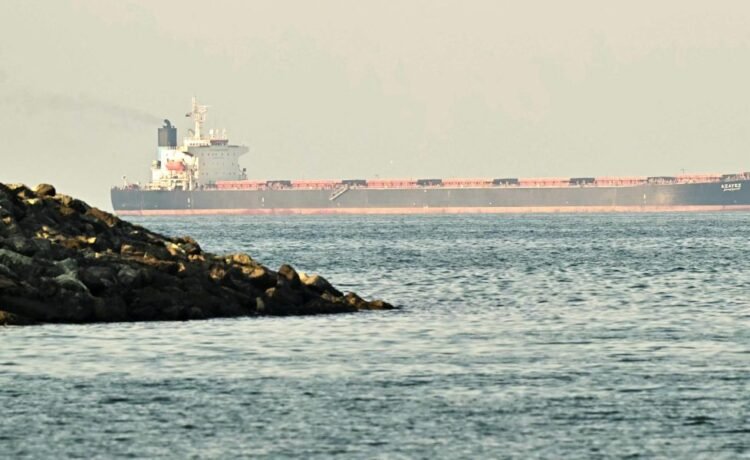
The Strait of Hormuz has become the center of the energy universe again after the U.S. and Israel began bombing Iran over the weekend.
In retaliation, the regime’s Islamic Revolutionary Guard Corps has launched missiles at vessels near the critical choke point in the global energy trade, bringing ship traffic there to a virtual standstill.
While Iran has yet to take more aggressive measures that would close the strait, top shipping companies are avoiding it as a precaution, sending oil prices higher.
According to the U.S. Energy Information Administration, an average of 20 million barrels of oil a day flow through the strait, or the equivalent of about 20% of global petroleum liquids consumption and about one-quarter of total global seaborne oil trade.
In addition to oil, about one-fifth of global liquefied natural gas trade also passes through the Strait of Hormuz, primarily from Qatar, EIA says.
Given its importance to the energy trade, the strait’s closure would cause massive turmoil in markets. Analysts have estimated that it could send crude prices to $100 per barrel.
Any closure might entail use of mines, patrol boats, aircraft, cruise missiles, and diesel submarines. While the U.S. Navy has deployed a formidable array of ships to the region, clearing the strait could take weeks or months.

But there are alternative routes that could help mitigate some of the effects of a closure.
For example, state-run energy giant Saudi Aramco operates a crude oil pipeline that runs east and west from the Abqaiq oil processing center near the Persian Gulf to the port of Yanbu on the Red Sea, according to EIA.
The United Arab Emirates operates another pipeline that bypasses the Strait of Hormuz by linking onshore oilfields to the Fujairah export terminal in the Gulf of Oman.
EIA estimates that the Saudi and UAE pipelines could be used to divert 2.6 million barrels per day from the Strait of Hormuz.
That compares with 5.5 million barrels per day of crude and condensate that Saudi Arabia exported through the strait in 2024.
Iran also has a pipeline and export terminal on the Gulf of Oman that could bypass the Strait of Hormuz. The pipeline’s capacity is about 300,000 barrels per day, but its actual use has been far less than that. During the summer of 2024, Iran exported fewer than 70,000 barrels per day through that alternate route and stopped loading cargoes after September 2024, according to the EIA.
By contrast, the vast majority of Iran’s oil exports, which averaged about 1.9 million barrels per day in December, go through the Strait of Hormuz.
Many analysts see an Iranian closure of the strait as unlikely since doing so would devastate its own economy in the process and trigger a potentially catastrophic response from the U.S.
In a column in Foreign Affairs magazine last June, Kenneth Pollack, a former CIA Persian Gulf military analyst and former director for Persian Gulf affairs at the National Security Council, said close of the strait would quickly transform Iran from a “sympathetic victim to a dangerous nemesis in the eyes of most other countries,” while Western countries and perhaps even China would use force to reopen the strait, he predicted.
An earlier version of this story ran on June 23, 2025.
This story was originally featured on Fortune.com