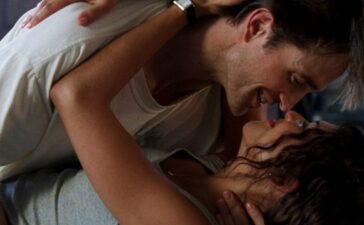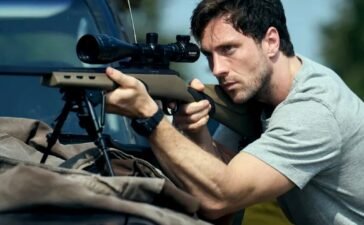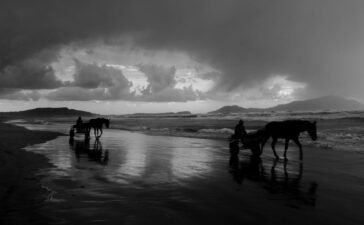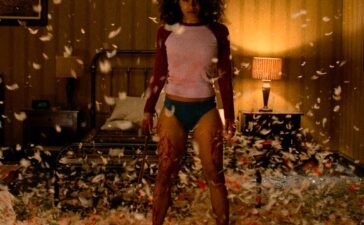


Amanda Seyfried is unwrapping a magic set she just purchased from Hamleys as I walk into a hotel room in London to interview her. She wants to share its delights with me. We are speaking a couple of days after her appearance at the 16th Governors Awards in Hollywood – she’s warm, welcoming and full of animated spirit and humour as she tells me how excited she was to finally meet Steven Spielberg. Seyfried is an actor who has balanced commercial hits with more hard-edged indie works. There was her early appearance in Mean Girls, followed by Mamma Mia!, which cemented her as one to watch. Her roles in Jennifer’s Body and Lovelace revealed a riskier side, and she dazzled as Marion Davies in David Fincher’s Mank. And yet her devoted and daring performance in The Testament of Ann Lee is unlike anything she’s ever done before.
LWLies: Can you pinpoint the exact moment you tapped into the role of Ann Lee?
Get more Little White Lies
Seyfried: Really tapping into the character actually came before we even started shooting. I was lying on the floor of the studio with Mona [Fastvold] and my dog, trying to find the right feeling to record ‘Beautiful Treasures’. It’s a montage of three different times in Ann’s life. The first is happy and in love, the second is pregnant and waiting and longing, and the third is grief. There are three different versions of the dance and everything is mixed together so I had to record ‘Beautiful Treasures’ many, many times and then sing it live. When I was in the studio, Mona was saying, ‘Let’s do it again but now just cry through it, just whisper through it…’ it was relentless. By the time I got on set I’d got it and that was liberating. Before you get to that point it is exhausting, but that’s okay, that’s why it’s so special.
There is an orgasmic and primal feeling to the dance sequences. What were the conversations you had with choreographer Celia Rowlson-Hall?
I was clueless as to what this movie would look like when I was reading the script and what the hymns would actually sound like. The script is very unconventional, in the best, most beautiful way. Not being able to wrap your head around something early on is normal but it’s scary because you think, ‘Am I the right person for this if even I can’t see this?’ I started working with Celia in the winter. We were shooting in the Hancock Shaker Village in Massachusetts in the middle of a snowstorm. I am not a dancer. It takes a long time for my brain and body to connect to create muscle memory. What I understood was that it was probably going to become intuitive but I needed to keep dancing. I would see videos of Celia and I understood it to be really abstract and very feral. It’s almost just an extension of emotion. For this film I had to show my soul in a way I haven’t really been familiar with before.
You were last in London in October, when you performed in London’s Café Oto with Daniel Blumberg…
I’ve never had an opportunity like that before. I met him on Zoom a couple of weeks before I met Celia. Even though his rhythm is not the same as mine… it’s not the same as anyone’s, so that’s what makes him so unique. He doesn’t know music theory, he doesn’t know how to read music. I come from a more technical background. I started music when I was seven. I started playing piano, singing opera and playing guitar. It comes from somewhere else for him. It’s more abstract and from the pit of his soul, it’s almost…
…guttural?
Yes! And a lot of music is, but he’s unafraid when it comes to music. These songs are not easy to sing. They don’t sound good all the time. They’re hard to sing when you’re moving. I don’t have enough breath for certain phrases. I couldn’t listen to myself when I sang and that was tricky. The whole thing was definitely a new understanding of what was needed. The same way I have to take my ego out of the equation when I’m acting, I had to take my ego out when I was listening to what I’m sounding like. I don’t trust my instrument the way I trust Mona and Daniel. I have to trust that they hear what they want to hear.
It sounds like working with Daniel and on this film changed you and your relationship with music.
It hasn’t really changed my love for folk music. It opened me up more to instrumental music. Playing at Café Oto was so heart-opening and so surreal because, for the first time, I just sang. I wasn’t afraid. Usually I have a crippling fear of singing live and I was just present there. I had a glass of wine, I was playing the bell and I was singing into the microphone. I wasn’t afraid of it for the first time in my life. Actually, I think you’re right, this movie has changed me.
It sounds like a liberating experience. You also had to learn the Manchester accent…
I stayed away from the contemporary Manchester accent. Things evolve over time so in order to make it feel less contemporary, our dialect coach, Tanera [Marshall], wanted to dilute it a little bit. Peterloo was the movie specifically that we all watched and we used it as a bible. There are certain scenes that really helped me find my voice as an empowered woman. Maxine Peake of course is from Manchester, and she is of this age, but I needed a reference and I felt like Maxine was the safest way to go.
Peterloo is great. I interviewed [its director] Mike Leigh recently, I was terrified…
It’s a beautiful movie. When it comes to directors I’m always a bit intimidated. Directors for me are always like ‘Mummy and Daddy’. Mona’s my mummy – on set we actually called her [Amanda adopts a Manchester accent] ‘Mother Mona!’
We should talk about your relationship with Mona because you previously worked with her on [the 2023 TV series] The Crowded Room…
That was the first time I worked with her, but I already knew her. I met her in my early twenties. We have many mutual friends in Brooklyn. She chose me because she knew I would give it everything. She knew that I would show up. She knew that it was a challenge and she knows that I’m not a pussy! I’m not precious at all and she knows I’m not going to give her a hard time. She has such a clear vision and she knows what she wants and she directs beautifully. She holds the room. She supports and nurtures the room but she also controls the room. There’s something very maternal about ‘Mother Mona’ but she asks for what she needs in a very simple and direct way.
There’s one point where Ann is on the ship and she has annoyed everybody and she defiantly continues to dance and chant. It’s so funny. Do you and Mona share a sense of humour?
Yes. She’s Scandinavian so she’s got a lot of manners and she’s very proper, but she can be quite dark and that’s part of the reason we get along so well. When I introduce audiences to the movie I like to say that you shouldn’t be afraid to laugh. It’s absurd at times, because the Shaker religion is absurd. We have a shared appreciation for the absurd, and the way she navigates that and the way she writes, you can understand that’s what she’s going for. She’s so funny. We had a lot of fun with it. There is a lot of darkness and grief with this film too. You gotta hold both sides of that and it’s very hard to do.
I think it very much does that… So, on a spiritual level did you have any curiosity when it came to religion?
I was with somebody in my teens when I was living in Hollywood and we started going to this Presbyterian church. We would go together and sing and I started thinking I had this faith. I even started going to a Bible-study class because I was new to town and wanted to belong to something. Then it dawned on me a year after we started going that I really just like to go to sing!
That’s what John Paul Jones, the bassist in Led Zeppelin, said about his early roots in music. He wasn’t religious, he just went to church to play music.
You have community and music at church and it’s free. Did I agree with everything? Most of it. A lot of religions are very confusing to me. The basis of religion, I always thought, was to lift each other up and be kind.
That’s what Ann Lee tried. So that sense of euphoria, it seems you get that a lot from music, but when you connect with a director, is that…
It’s everything! I just did a movie with Tim Blake Nelson [The Life and Deaths of Wilson Shedd] and ‘euphoric’ is a very good word to describe it. It’s too much to describe every day on set but I had moments of that. He made me understand things through this poetry in his direction. It was delicious to take his note and thread it through all my thoughts and feelings. I’m truly an actor. I get such a kick out of it. It’s a beautiful chaos. I remember I was with Thomasin [McKenzie] and Mona watching the film at Venice and we were all holding hands. It felt like a sisterhood. I cried hysterically at the funeral scene, because of the culmination of the whole experience, in a film about a woman whose whole existence was under the threat of erasure –this was a beautiful person, as nuts as she was. Her intention was incredibly powerful and pure for so many people.