

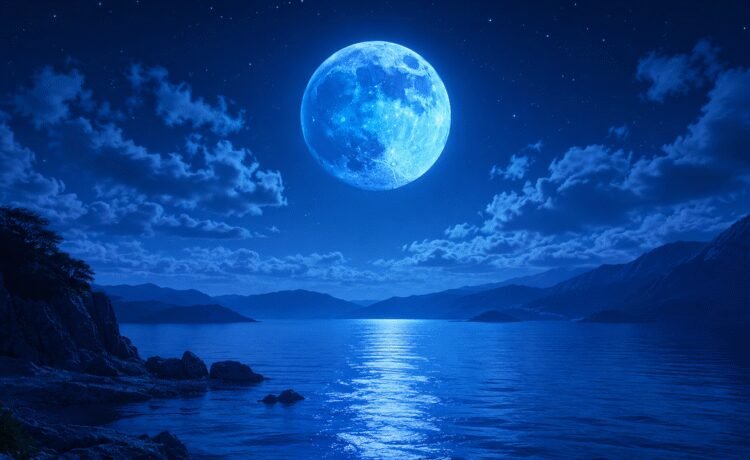
As per the Science Alert, a Blue Moon refers to the second full moon happening within the same calendar month. A Micromoon, meanwhile, occurs when the Moon becomes full while placed near apogee, the farthest point in its orbit around Earth. Because of this greater distance, the moon seems to be slightly smaller and dimmer than a normal full moon.
Astronomers state that the full moon will reach peak illumination at 8:45 UTC on May 31. During that time, the Moon will be positioned around 252,360 miles away from Earth. Although the difference may not be dramatic to the naked eye, scientists estimate the micromoon could seem to be almost 6% smaller and nearly 10% dimmer than an average full moon.
Despite the term “Blue Moon,” the lunar surface will not really appear blue in color. Instead, observers are anticipated to see the familiar pale white or golden-orange appearance often associated with moonrise near the horizon. Experts describes that the name “Blue Moon” relates only to the timing of the full moon within the calendar rather than its physical color.

Why Blue Moons Are Relatively Rare
Blue Moons do not occur every year because the lunar cycle lasts around 29.5 days, which does not perfectly match the structure of calendar months. As a result, an additional full moon occasionally appears within a single month, creating the phenomenon known as a Blue Moon. Events combining both a Blue Moon and a Micromoon are regarded as less common.
The lunar event may be particularly striking in areas across the Southern Hemisphere and the Pacific, where the Moon is anticipated to appear close to Antares, the bright reddish star located in the constellation Scorpius. Observers in the Northern Hemisphere may also notice the Moon positioned near the star during the night.
Best Time and Place to Watch the Micromoon
Experts advise watching the Moon shortly after moonrise or in the late evening hours for the best viewing experience. In the United States, the moon is anticipated to reach its peak during the early morning hours at around 4:45 a.m. ET on May 31.
Skywatchers are urged to choose locations with an unobstructed eastern horizon and minimal artificial lighting. Open spaces like beaches, rooftops, parks, and countryside areas often provide clearer views of moonrise. Checking weather predictions ahead of time is also recommended since cloud cover may minimize visibility.
Understanding the Difference Between Micromoons and Supermoons
As per Time and Date, the Moon’s orbit around Earth is elliptical, meaning the distance between Earth and the Moon changes continuously. When the Moon nears perigee, its closest point to Earth, a full moon may seem to be larger and brighter, creating what is commonly referred to as a supermoon. During apogee, however, the Moon appears smaller, generating a micromoon.
Researchers explain that a micromoon may look almost 12% to 14% smaller than a supermoon and around 6% smaller than an average full moon. Even so, the size difference can be challenging to notice without side-by-side comparisons.
Lunar Events Continue to Fascinate Skywatchers
Astronomy experts cite that micromoons can occur several times throughout the year, unlike Blue Moons, which appear less frequently. Reports from EarthSky indicate that the upcoming June 2026 Strawberry Moon may also qualify as a micromoon, possibly creating a rare sequence of several micromoons in a row.
Scientists also point out that the Moon remains to influence Earth’s tides regardless of whether it appears larger or smaller in the sky. During micromoons, tidal changes named apogean spring tides may happen, producing slightly weaker tidal variations compared to standard full moons.
As anticipation builds for the weekend event, astronomers and sky enthusiasts alike are preparing to witness a rare combination of lunar timing and orbital positioning that highlights the continuing beauty and predictability of the night sky.
FAQs:
Q1. What is a Blue Micromoon?
A Blue Micromoon is a full moon that combines two events: a Blue Moon and a Micromoon. It occurs when the second full moon of a month happens near the Moon’s farthest point from Earth.
Q2. Will the Moon actually appear blue?
No, the Moon will not physically look blue in the sky. The term “Blue Moon” refers only to the timing of the full moon within the calendar.