

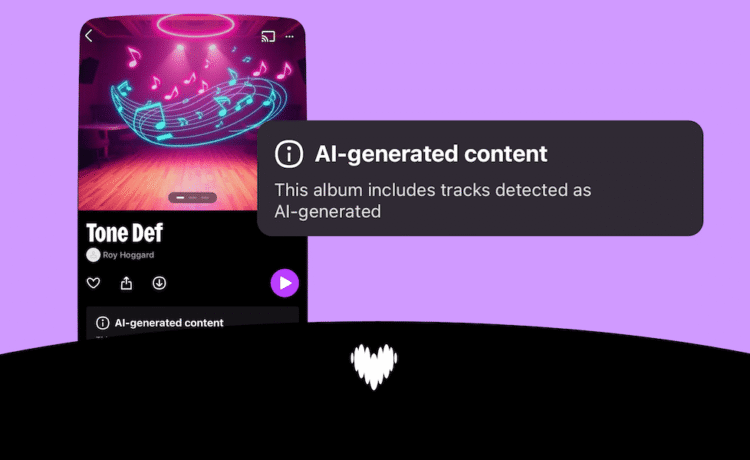
Last year, Deezer introduced an AI detection tool that automatically tags fully AI-generated music for listeners and removes it from algorithmic and editorial recommendations.
The company announced on Thursday that it’s now making the tool available to other streaming platforms in an effort to help address the rise of AI and fraudulent streams, as well as promote transparency within the music industry and make sure human artists still get the recognition they deserve.
Alongside the move, Deezer reported that 85% of streams from fully AI-generated tracks are deemed fraudulent. Notably, the service now receives 60,000 AI tracks per day, totaling 13.4 million AI-detected songs. By contrast, in June of last year, fully AI-generated music made up 18% of daily uploads, surpassing 20,000 tracks.
Deezer claims its AI music detection tool can identify every AI-generated track from major generative models like Suno and Udio. In addition to excluding AI-generated tracks from recommendations, Deezer’s tool demonetizes them and excludes them from the royalty pool, as the company aims to fairly compensate musicians and songwriters.
The tool’s accuracy is 99.8%, a company spokesperson told TechCrunch.
Deezer CEO Alexis Lanternier says there has been “great interest” in the tool, and several companies have “already performed successful tests.” One such company is Sacem, the French management company that represents over 300,000 music creators and publishers, including David Guetta and DJ Snake.
The company didn’t provide pricing information or disclose which additional companies are interested in adopting the tool. A spokesperson told us that the cost varies based on the type of deal.
Techcrunch event
Boston, MA
|
June 23, 2026

There is increasing concern about AI companies using copyrighted material to train their models, as well as about methods being used to manipulate streaming systems and commit fraud.
One instance of music streaming fraud occurred in 2024, when a North Carolina musician was charged by the Department of Justice (DOJ) with creating AI-generated songs and using bots to stream them billions of times, resulting in more than $10 million in stolen streaming royalties. Additionally, AI bands like The Velvet Sundown have gained millions of streams.
Bandcamp recently got fed up and banned AI-generated music altogether, while Spotify has updated its policy to address the rise of AI tracks, clarifying when AI is used in music production, reducing spam, and explicitly stating that unauthorized voice clones are prohibited on the platform.
By contrast, major record labels have resolved lawsuits with Suno and Udio, appearing to embrace AI-generated music. Last fall, Universal Music Group and Warner Music Group struck deals with these AI startups to license their music catalogs, ensuring artists and songwriters are compensated when their work is used to train AI models.
In recent years, Deezer has taken significant steps to address concerns about AI-generated music. In 2024, it became the first music streaming platform to sign the global statement on AI training, joining actors Kate McKinnon, Kevin Bacon, Kit Harington, Rosie O’Donnell, and other notable creatives.
Hopefully, Deezer’s latest decision to sell its detection tool will set a precedent for other music streaming platforms to take similar actions to defend human artists and fight fraud.