
OVERLAND PARK, Kan. (RNS) — As Manahil Khan stood at the balloon-decorated entrance of Salsabeel Cafe, she took in the stream of students and elders sipping coffee drinks in what once was the prayer hall she’d run around in as a child.
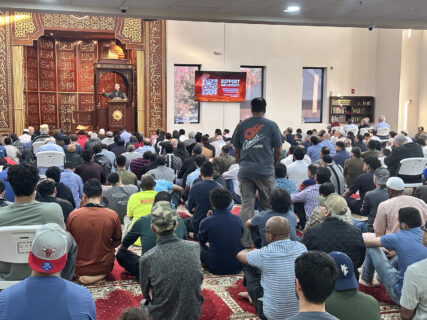
The cafe’s opening at the Islamic Center of Johnson County in the Kansas City suburbs in early November marked a milestone for the small but “strong” Muslim community, Khan said. It’s among a growing number of United States mosques creating relaxed “third spaces” — social spaces outside home and work — for young Muslims to gather without the formality of religious events.
“I remember when they first laid down the carpet, (and) the huge discussion of if it would even be possible to open a new building,” Khan, 27, said. “It’s almost unbelievable that we are having a grand opening for a third space.”
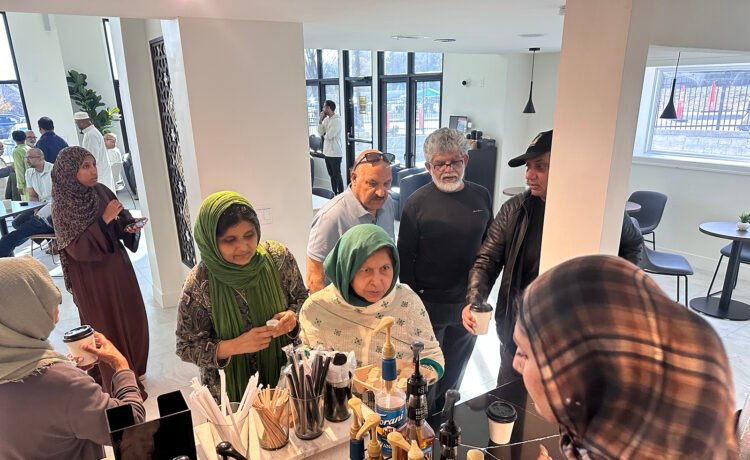
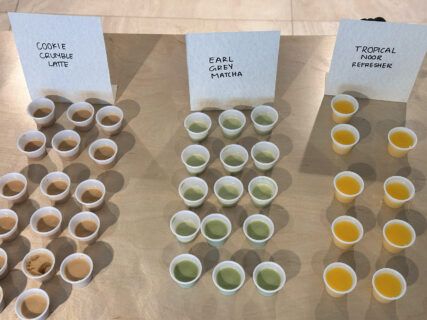
Coffee shops opening in or close to places of worship aren’t a new concept. In recent years, some American churches have opened coffee shops to draw new members amid declining attendance. Salsabeel Cafe, steps away from ICJC’s purpose-built mosque, features a full coffee bar with professional machines, curated specialty drinks and spacious seating. Except for a few Islamic geometric artworks hanging on its walls, Salsabeel Cafe doesn’t appear to be an exclusively religious place, and that’s by design.
“These are places where you don’t have to be so devoutly religious and performing a certain kind of devout piety in order to be welcome,” said Zareena Grewal, an assistant professor of religious studies at Yale University who studies U.S. Muslim history. “You could just come and chill and have a cup of tea or coffee with your friends, and maybe the adhan (call to prayer) comes on and you go and pray. And even if you don’t, at least you’re there. And maybe next time, you will.”

Fulfilled orders at the Islamic Center of Johnson County’s Salsabeel Cafe, Nov. 14, 2025, in Overland Park, Kan. (RNS photo/Kit Doyle)
Muslims in the U.S. are much younger on average than the general public, with a third of all Muslim adults now under the age of 30, according to data from Pew Research Center. And evidence suggests younger Muslims are less religiously engaged than older Muslims, said Besheer Mohamed, a senior researcher at Pew.
“How to engage with young people is certainly more pressing for the Muslim community than for other communities just on purely demographic reasons,” Mohamed said.
A 2020 survey by the Institute for Social Policy and Understanding also found that mosques “are not attracting a significant percentage of Generation Z and young Millennials.” It’s a troubling trend that mosque leaders at ICJC have noticed in recent years.
“We saw that high schoolers, college-aged youth and young professionals — that age group goes out in the world and they really don’t connect back to the masjid,” said Jawaria Khalid, a mosque board member.
Khalid said Salsabeel Cafe can be a place that invites young people back inside and offers them a sense of community.
“Expectations are always on us,” said 18-year-old Zaytoon Malik, with an iced matcha latte in hand. “Now we can just be a Muslim and everyone here is good with that. It’s a place where we can gather together, feel safe and like we belong somewhere.”

Zaytoon Malik, 18, center right, talks with friends at the grand opening of the Islamic Center of Johnson County’s Salsabeel Cafe, Nov. 1, 2025, in Overland Park, Kan. (RNS photo/Ulaa Kuziez)
The trend away from worshipping in mosques for young Muslims was on Naeem Muhammad’s mind when he started Qahwa Cafe inside All Dulles Area Muslim Society, known as ADAMS Center, in Sterling, Virginia.
He said a survey conducted by youth in the community 10 years ago showed they wanted a space to do homework, hang out and listen to lectures, and a cafe fit the bill. Qahwa Cafe opened in 2021 and describes itself as “Part cafe. Part youth center.”
With years of experience in coffee shops and in youth mentorship, Muhammad helped create an aesthetic and professional space that serves high-quality drinks at affordable prices. The tab for a coffee and snack is about $5, below market rate.
“This was supposed to have some cool factor,” Muhammad said. “This is for American-born Muslim kids here that were looking for alternatives to Starbucks.”
Inspired by ADAMS, Amana Siddiqi sought to bring a similar concept to the Islamic Society of Orange County in Garden Grove, California. She sought to turn a seldom-used bookstore into a small cafe “just to see the potential.”
Siddiqi took advice from Muhammad and got to work building a coffee cart, sourcing vendors and training baristas. Since Barakah Cafe opened in 2023, it’s been a popular fixture in the mosque community, attracting teenagers and elders alike, she said.
“Everybody that’s been to the cafe is like, ‘We can’t imagine not having this,’” Siddiqi told Religion News Service.
The cafe is connected to the mosque’s school, offering a regular stream of customers before and after school drop-offs. “The dad scene in the morning at our coffee shop is pretty impressive,” Siddiqi said.
Occasionally, she said, visitors will come to the public cafe from a Google Maps or Yelp search, not realizing the shop is connected to a house of worship. At the visitors’ requests, that sometimes turns into mosque tours and organic exposure to the faith, she said.
The cafes also provide an additional revenue source for the mosques. But Siddiqi and Muhammad both said it’s most rewarding to see young people use the cafes to host events that are meaningful to them, including hip-hop and Islam discussions, poetry nights, singles gatherings and skin care workshops.
“The cafe affords us to be more creative than any other space inside the mosque,” Muhammad said.

Hassan Qureshi, right, takes orders at Salsabeel Cafe after Friday afternoon prayers, Nov. 14, 2025, in Overland Park, Kan. (RNS photo/Kit Doyle)
The American mosque has long been about more than worship, where the heart of the experience is social gathering — with spaces such as cafeterias and bookstores helping foster that community. Grewal, the Yale researcher, explained that cafes and businesses were fixtures of traditionally Black storefront mosques in cities such as New York.
The historic Mosque of Islamic Brotherhood in Harlem, for example, established an herbal tea room “as more than an organizational business venture, but as a social gathering place for the exchange of ideas, discussions about Islam, and camaraderie,” reads the mosque’s archived website.
With an influx of Muslim immigrants from the Middle East, South Asia and parts of Africa after the Immigration Act of 1965, Muslim American demographics began to shift. With that came a suburbanization of mosque communities that sometimes left behind urban commerce spaces, Grewal said.
“These cafes are in some ways hearkening back to that earlier tradition of having business within the mosque space,” Grewal said.

Patrons visit at the Islamic Center of Johnson County’s Salsabeel Cafe, Friday, Nov. 14, 2025, in Overland Park, Kansas. (RNS photo/Kit Doyle)
Grewal added that mosque cafes may also help address another challenge facing young Muslims: finding someone to marry. As in many religious groups, she said, Muslim Americans often feel anxious about ensuring their children marry within the faith.
“Muslim youth need places where there can be socialization that is still considered within the contours of what is healthy or allowable within these Muslim communities,” Grewal said.
Siddiqi said she hopes her cafe can play exactly that role. “I am waiting for my first marriage, that they met at Barakah Cafe,” she said. “I can’t wait for that.”

Syeda Mahnoor, team lead at Salsabeel Cafe, works the espresso machine, Friday, Nov. 14, 2025, in Overland Park, Kansas. (RNS photo/Kit Doyle)
Before offering a prayer at the opening of Salsabeel, the Kansas City-area mosque cafe, Imam Dahee Saeed thanked God and his community for creating an important place “to pray and play.”
“It’s a safe place,” said 13-year-old Adam Khatib as he sampled a mango drink with his friend, Suhaib Ahmad. “Parents sometimes don’t let their kids go to certain places. But I can come here to hang out with my friends after soccer practice or prayer.”
For Summaya Ahmed, Suhaib’s mother, Salsabeel Cafe is a place where her children can be themselves.
“We stand out as Muslims so much,” she said. “This is a place where my kids can feel like it’s OK to be who they are. I feel like it helps them hold on to their identity a little better.”

Patrons visit at the Islamic Center of Johnson County’s Salsabeel Cafe, Friday, Nov. 14, 2025, in Overland Park, Kansas. (RNS photo/Kit Doyle)