

For the better part of a decade, Whoop sold itself as a secret weapon for serious athletes. LeBron James was convinced to slap on the company’s fitness band in Whoop’s first year. Michael Phelps came soon after. Other Whoop wearers include Cristiano Ronaldo, Patrick Mahomes, and Rory McIlroy. The message to the public? The world’s best performers track their bodies with this device, and you can, too.
It has worked. Whoop, the Boston-based health wearable company that Will Ahmed founded in his senior year at Harvard, now operates in more than 200 countries, and, according to Ahmed, grew revenue more than 100% last year, as well as reached cash-flow positive. The hardware — a band worn around the wrist, bicep, or torso — measures sleep, recovery, heart rate variability, and a growing list of biomarkers. The subscription model, which bundles hardware and software for between $200 and $360 a year — the device itself included, with no separate purchase required— has proven remarkably sticky: 83% of monthly active users open the app on any given day, a ratio that Ahmed says trails only WhatsApp.
The next chapter is a harder sell.
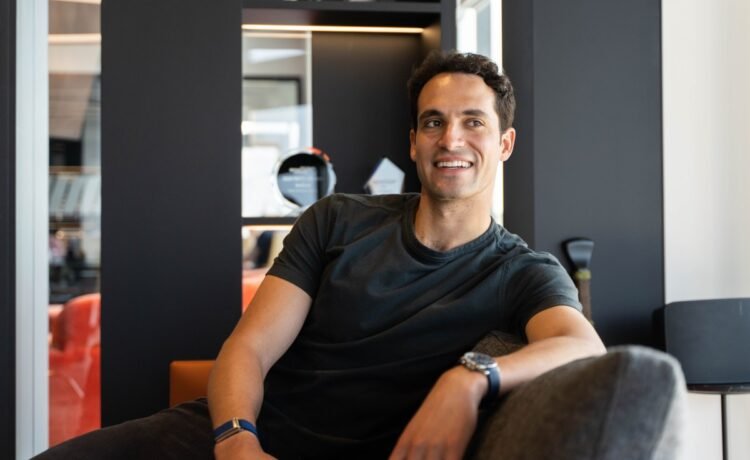
Ahmed, 36, wants Whoop to be less of a performance tool and more of a life-saving one — a continuous health monitor that doesn’t just help you recover from a hard workout, but one day tells you, unprompted, that you’re about to have a heart attack and need to get to a hospital.
The company has already launched medically cleared features including ECG monitoring and atrial fibrillation detection — a capability that flags an irregular heartbeat that can lead to stroke — and what it calls blood pressure “insights,” which Ahmed says makes Whoop the first wearable to offer the feature.
The FDA challenged that last one in a warning letter last summer, arguing the feature constituted medical diagnosis rather than wellness monitoring; Whoop said the FDA was “overstepping its authority,” and kept building.
Today, a blood testing partnership with Quest Diagnostics — which has over 2,000 U.S. locations — lets members take a blood test and upload their biomarkers directly into the app, where a clinician reviews the results alongside their Whoop data. A feature called Health Span calculates your biological age. Ahmed says it has become the company’s most popular feature since its launch in May of last year.
Techcrunch event
San Francisco, CA
|
October 13-15, 2026
The device itself has no screen, no notifications, no step counter. The decision was strategic from the start. “If you have a screen, then you’re a watch,” he tells TechCrunch via a Zoom call. “And if you’re a watch, then you’re competing with a lot of other watches, because people will never wear two watches.”
Not only can Whoop be worn alongside whatever watch you already own, he suggests, it can be tucked away entirely, a sensor slipped into a bicep sleeve, a sports bra, or a pair of shorts, disappearing into your clothing. It’s probably safe to say the overwhelming majority of Whoop’s customers want to wear the band as a fashion statement, but when asked directly, Ahmed offers that the company’s apparel line, launched in 2021, grew 70% last year.
But Whoop isn’t alone in moving beyond its roots to wanting to pull everyone into the tent. Oura, the Finnish company behind the smart ring that has become Whoop’s most direct rival, has built a large and loyal following of its own — largely among the kind of high-performing professionals who approach their bodies with the same rigor they bring to their work.
Oura’s model works differently. Customers buy the ring outright for around $350, then pay roughly $70 a year to access the platform. When I spoke with Oura chief product officer Dorothy Kilroy last fall, she said retention at the 12-month mark was hitting the high 80s, a remarkable figure for any wearable, most of which quickly wind up in a drawer.
Both companies now say women are their fastest-growing segment, and last fall they announced blood-testing partnerships within one day of each other — a coincidence that neither side was eager to discuss.
Whoop’s numbers still reflect where it started. Though Ahmed is circumspect about sharing too many figures publicly, he says Whoop skews more male than female. He also says the business is now roughly evenly split between the U.S. and the rest of the world — a shift from just a few years ago. Whoop formally ships to 60 countries.
What has set Whoop apart, at least in its telling, is that its most famous users didn’t have to be persuaded. The Australian Open earlier this year instructed players including Carlos Alcaraz to remove their Whoop bands mid-tournament, despite the device having been approved by the International Tennis Federation. The players pushed back. Though Whoop has brand ambassadors — Aryna Sabalenka is one — others like Alcaraz and Jannik Sinner, both of whom wear Whoops under their wristbands, simply didn’t want to take them off.
“It created a whole set of media outrage,” Ahmed says a little gleefully of the resulting coverage, “and further spotlighted the fact that all these very talented people are just organically wearing Whoop because of the value it provides.”
Ahmed is careful to protect it. The company has a long-standing policy against giving athletes equity in exchange for wearing the band. His reasoning? If they like the product, they’ll wear it regardless. Formal partnerships with Ferrari, the PGA Tour, and UCI mountain biking work differently; they’re about putting the brand in front of larger audiences who share the same sensibility.
Oura, by the way, is doing the same math. Founded just one year after Whoop, the company is widely reported to be exploring an IPO. If Oura goes public first, it sets the financial benchmarks — revenue multiples, growth rates, retention metrics — against which Whoop will be measured. Whoop currently employs around 750 people and is in the middle of hiring 600 more.
Ahmed gives little away on the subject. “If we focus on building great technology and growing our business,” he says, “we’re going to be happy with Whoop when we’re a public company, independent from who goes public first.”
He speaks throughout the conversation the way someone does when they’ve thought carefully about what they should and shouldn’t say. Ahmed was captain of the Harvard squash team and counts Ali Farag, who went on to become world number one, among his former teammates — though he’s quick to note that proximity to greatness shouldn’t be mistaken for greatness itself.
“You probably have the wrong impression of how good I am at squash on the basis of me being teammates with him,” he jokes.
He started building what would become Whoop in 2011, reading hundreds of medical papers while studying economics and government, trying to solve a problem he’d experienced firsthand: overtraining without any reliable way to measure its toll on his body.
Whoop isn’t just Ahmed’s first company. It has been his only full-time job. When I ask whether he’d recommend that path to a founder sitting where he was in 2012, it’s the question he answers most freely.
Starting a company is, for the right person with the right intentions, “without question, the most extraordinary thing you can do in your career.” But it is, he adds, “a very painful experience to be an entrepreneur and to try to build something from scratch, and you have to have a reasonably high pain threshold that I think often gets lost in the glamour of fundraising announcements and milestones.” You need to be, he says, “more obsessed with the problem you’re solving than with the idea of being a founder.”
He doesn’t seem to have much doubt about which side of that line he’s on.