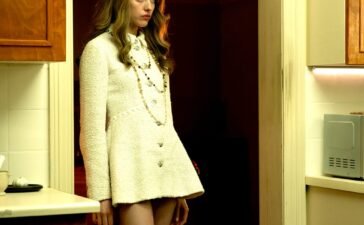


The supporting cast fair no better. Edward Linton (Shazad Latif) is also retooled, now a nice but dull man who lives in a house so antithetical to his sensibilities it’s laughable we’re asked to believe he decorated it in such a manner. His ward Isabella Linton is a simple, spoiled young woman in awe of Cathy until she sets her sights on Heathcliff; Alison Oliver fairs well as the comic relief, though the character’s quick progression from helpless innocent to apparently willing submissive feels like an enormous jump. The standout in the cast is good old Martin Clunes as Cathy’s miserable drunkard father Mr. Earnshaw – a scene where he mocks Heathcliff’s affection for Cathy stands out as a highlight and one of the few instances where the emotional stakes of Wuthering Heights feel sincere. But Fennell can’t help but play his death for laughs, as if the film is allergic to letting anything too grimly tragic linger on screen.
In sanding down Heathcliff’s brutality he becomes less complex, reduced to a beautiful sad man with a broad Keighley accent and some billowing shirts. Fennell instead squarely positions Cathy’s maid Nelly (Hong Chau) as the true villain of the saga, a scheming, interfering scold who keeps Cathy and Heathcliff apart out of jealousy and is eventually responsible for the former’s untimely death. Her nuance is also lost in this lavish restaging, written off as the envy of a noble’s daughter born out of wedlock who can’t stand to see Cathy and Heathcliff happy. It’s a thankless role for Chau and absolves Cathy and Heathcliff, essentially writing off their own bad behaviour as little more than childish hair-pulling. (This is now the second film where Fennell has positioned a lower class character as the mastermind of a plot to bring down poor, helpless rich people.)
While fidelity to a novel is no guarantee of its success as an adaptation – some of the best adaptations are the most shamelessly unfaithful – one at least hopes that a filmmaker understands the text they’re trying to translate. Perhaps Fennell’s honesty in stating “There’s a version [of ‘Wuthering Heights’] that I remember reading that isn’t quite real, and there are things I wanted to happen that never happened” should be commended, but it’s hard to come out of Wuthering Heights with a sense that Fennell really wanted to reckon with what Brontë’s book is actually about: class, abuse masked as love, generational trauma and the stories we tell ourselves to justify doing bad things and having bad things done to us. All this is stripped away in favour of telling a more straightforward tragic love story – one that has more in common with ‘Romeo and Juliet’ (to the extent Isabella has a monologue recounting the plot of the play) than ‘Wuthering Heights’.
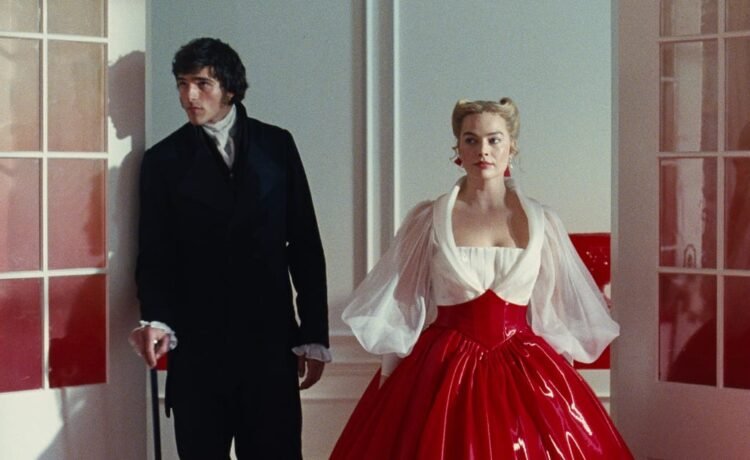
So what does Fennell bring to this world? Great gowns, beautiful gowns, by costume legend Jacqueline Durran, that nonetheless feel completely separate from the story being told around them. Suzie Davies’ undeniably impressive production design, particularly in making Thrushcross Grange feel like the Overlook Hotel if it was decorated by Simone Rocha, and one certified Charli XCX ft. John Cale anti-banger in ‘House’ (the rest of the Charli songs used in the film feel intrusive, notably ‘Chains of Love’ over the climactic, yet oddly lacking climax, Cathy and Heathcliff sex montage). Fennell’s eye for detail and ability to assemble a great roster of collaborators is not in dispute; she enthusiastically swings for the fences and there are absolutely striking visuals within Wuthering Heights, as there very much were in Saltburn (also shot by DoP Linus Sandgren). But what good is creating such a beautiful world if it’s so vacant? There is nothing that resonates below the surface here; this is a half-remembered story dressed in a beautiful gown that seems destined for TikTok fan edits and Pinterest mood boards rather than soul-stirring emotional catharsis. We are guided by the hand, instructed on how to feel at every moment, and trusted with nothing. If love cannot exist without trust, why are we doing any of this?
A final observation: in anticipation of the film’s release, Fennell programmed a series at the BFI IMAX of titles that inspired her version of Wuthering Heights, including Liliana Cavani’s The Night Porter, David Cronenberg’s Crash, Park Chan-Wook’s The Handmaiden, Baz Luhrmann’s Romeo + Juliet, Mervyn LeRoy’s Random Harvest and Catherine Breillat’s Bluebeard. A veritable bounty of great films that should have been a promising indicator of things to come, but in retrospect only serve as a warning that liking great art doesn’t necessarily result in making great art yourself. Then again, perhaps that’s never been Fennell’s intention. Great art certainly doesn’t sell H+M capsule collections or Kleenex brand collabs.